At the heart of our displays are advanced light field and photonic crystal technologies that create true 3D images visible from any angle. The systems are engineered for brightness, clarity, and reliability in commercial environments.
Our R&D team continually pushes the envelope with prototypes that blur the line between physical and digital worlds.
At NextGenHologram, we've developed proprietary technology that creates true volumetric holographic displays without requiring special glasses or headsets. Our systems combine advanced optics, high-performance computing, and innovative display techniques to create vivid three-dimensional images that appear to float in space.
Unlike traditional 3D displays that rely on stereoscopic techniques to create the illusion of depth, our holographic technology generates actual light fields that replicate how we naturally perceive objects in the real world. This results in more comfortable viewing experiences with no eye strain, even during extended use.
Our continuous research and development have led to breakthroughs in resolution, brightness, viewing angles, and interactivity, making our holographic displays practical for a wide range of professional applications.
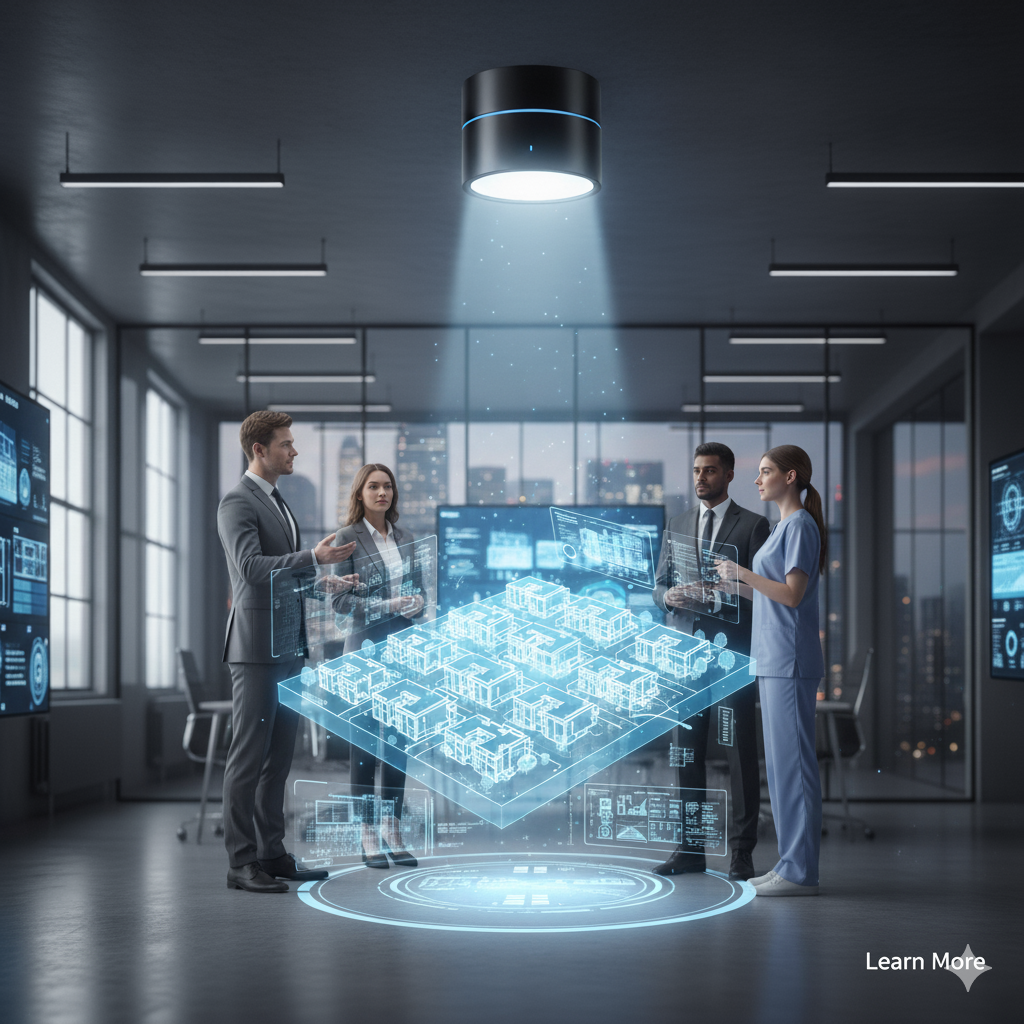
The core principles behind our holographic displays
Our systems generate complex light fields that accurately reproduce how light reflects off real objects.
Using proprietary spatial projection technology, light fields are positioned in 3D space.
Powerful GPU-accelerated processing enables seamless rendering of complex 3D models.
Maintains visual consistency from all angles allowing multiple viewers simultaneously.
Users interact with holographic content using intuitive gestures and touch.
Advanced algorithms process large datasets to deliver smooth holographic visuals.
The core innovations that power our holographic solutions
Custom optical systems ensure exceptional brightness and image clarity.
Specialized hardware handles complex rendering calculations in real-time.
Software tools help design and deploy immersive holographic experiences.
AI algorithms enable natural interaction with holographic elements.
Precise environmental mapping integrates holograms with real space.
Remote content management and real-time updates via cloud systems.
Understanding the advantages of true holographic technology
| Feature | NextGenHologram | Traditional 3D Displays | AR/VR Headsets |
|---|---|---|---|
| Viewing Experience | True volumetric visualization | Stereoscopic illusion | Requires headset |
| Multi-User Capability | Multiple viewers | Limited viewing positions | Individual only |
| Eye Comfort | No eye strain | Can cause discomfort | Motion sickness possible |
| Interaction | Gesture control | Limited | Controllers required |
Driving holographic innovation through continuous research
Continuous improvements in optical components and projection systems.
GPU-accelerated algorithms for faster holographic rendering.
Improving interaction, recognition, and rendering efficiency.
Natural control using hand gestures and voice commands.
Developing larger holographic displays for enterprise environments.
New use-cases across healthcare, education, and design industries.