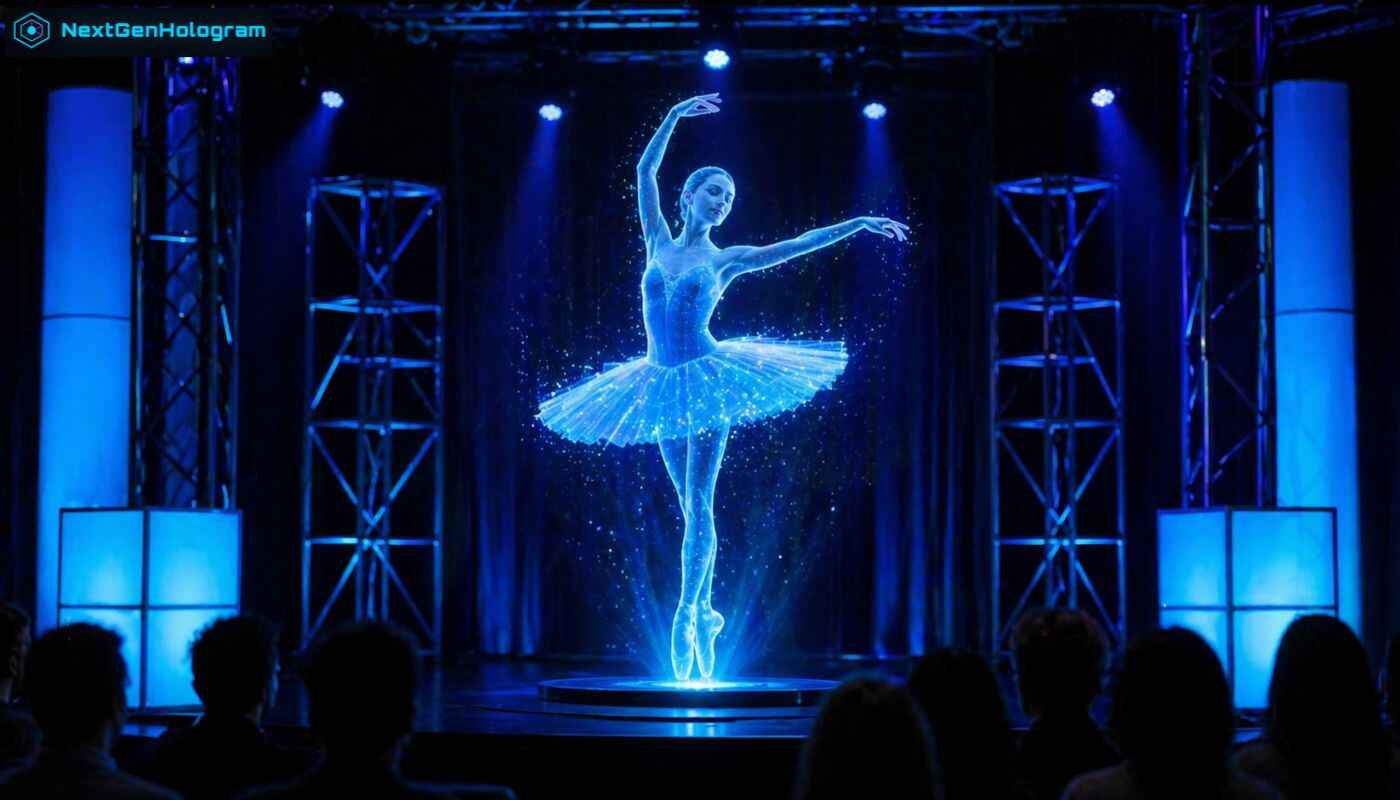
In live events and corporate presentations, grabbing and keeping attention is harder than ever before. In today’s competition, everyone’s screen in the room, even individual devices, is a struggle. That is why hologram projections have changed the game—converting ordinary slides into immersive, 3D experiences that make people feel like they have come from the future. Entirely, the use of showing 3D renderings of products, speakers, or images above the stage enhances how the audience reacts to the information presented, while not making it less comprehensible and memorable.
Role of Hologram Projections in Increasing Engagement
While traditional PowerPoints and video walls communicate in a flat, 2D style, hologram projections provide a third dimension by placing objects or outlines that appear before the eyes of the audience to float in mid-air, concentrating the attention of the room on space.
The main advantages include:
- Fairytale telling: Interrelations of spatial understanding are enhanced when complex data, product designs, or anatomical models are displayed in 3D.
- Text readability: Presented Renderings could be sent to an audience on a giant parchment or through a WhatsApp message; it’s part of the presentation!
- Enhanced attention: Researchers have shown that people retain information better if it is displayed in a strong 3D format as opposed to flat charts.
- Brand leverage: The use of hologram projections onstage would instantaneously signal innovation and tech-savvy know-how, thereby differentiating your event from the competition.
This kind of interaction could make all the difference for marketers, product launches, and training sessions, turning an ordinary presentation into a memorable moment. bed opportunities for the economy.
3D Holography Application in Different Sectors
The use of 3D holography is quite common now in the various areas where live presentations are considered an important part.
-
Conferences and trade exhibitions: Brands use 3D holographic projection of their products. These products appear physically detached in front of the onlooker so that he can observe the objects from all possible angles, but without actually touching the products.
-
Education and training: Universities and medical schools use holograms for the display of 3-D models of organs, molecules, or engineering assemblies, which the students can walk around and inspect.
-
Music and entertainment: Concerts and award shows propose massive hologram projections that "re-enlarge" the virtual player and permit fantasy creatures to take the stage.
-
Corporate and government: Holography is used by heavyweights for the virtual keynotes, where a remote speaker is seen lifelike on stage without the need for any travel.
Each application avails hologram projection's core strength: transforming abstract or complex content into a semi-plausible physical object.
Latest Hologram Technology and Live Event Setup
The latest technology in holography can now also be used on portable, battery-driven systems rather than big, custom-made stages. This offers a hologram project to a range of mid-sized venues and even boardrooms.
Everyday applications for such a setting are:
-
Peppers Ghost: This system deduced its name from an effect of the entire room when lit by a projector light reflecting in a slight incline on a transparent screen, simultaneously giving the appearance that a 3D element is floating above the stage.
-
3D Volumetric Displays: An array of 3D holographic images is constructed by flashing laser or LED light through a phosphor-matrix medium that appears to be glowing in 3D space.
-
One integrated control software: It allows the presenter to perform real-time adjustments such as rotating the hologram, zooming in on its parts, or triggering animations, in functionality comparable to a slide deck.
Such pieces permit the preplanned holographic performance to run in parallel to cues for voice-overs, lighting, and other stage cues.
Why Are Hologram Projections Worth Audience?
There are certain types of programs, such as major product launches, corporate roadshows, or high‑profile events, where hologram projections bring such a powerful advantage to the live experience that investing in such expensive technology is absolutely justified. They effectively transform the presentation into a memorable experience, give great, instant driving visuals for social media, and help in the understanding of complex concepts faster. Today, with the advent of modern holographic technology, these projections, once viewed as an exclusive industrial attribute, are subtly and only slowly becoming the norm of powerful, gripping, and unforgettable live presentations.