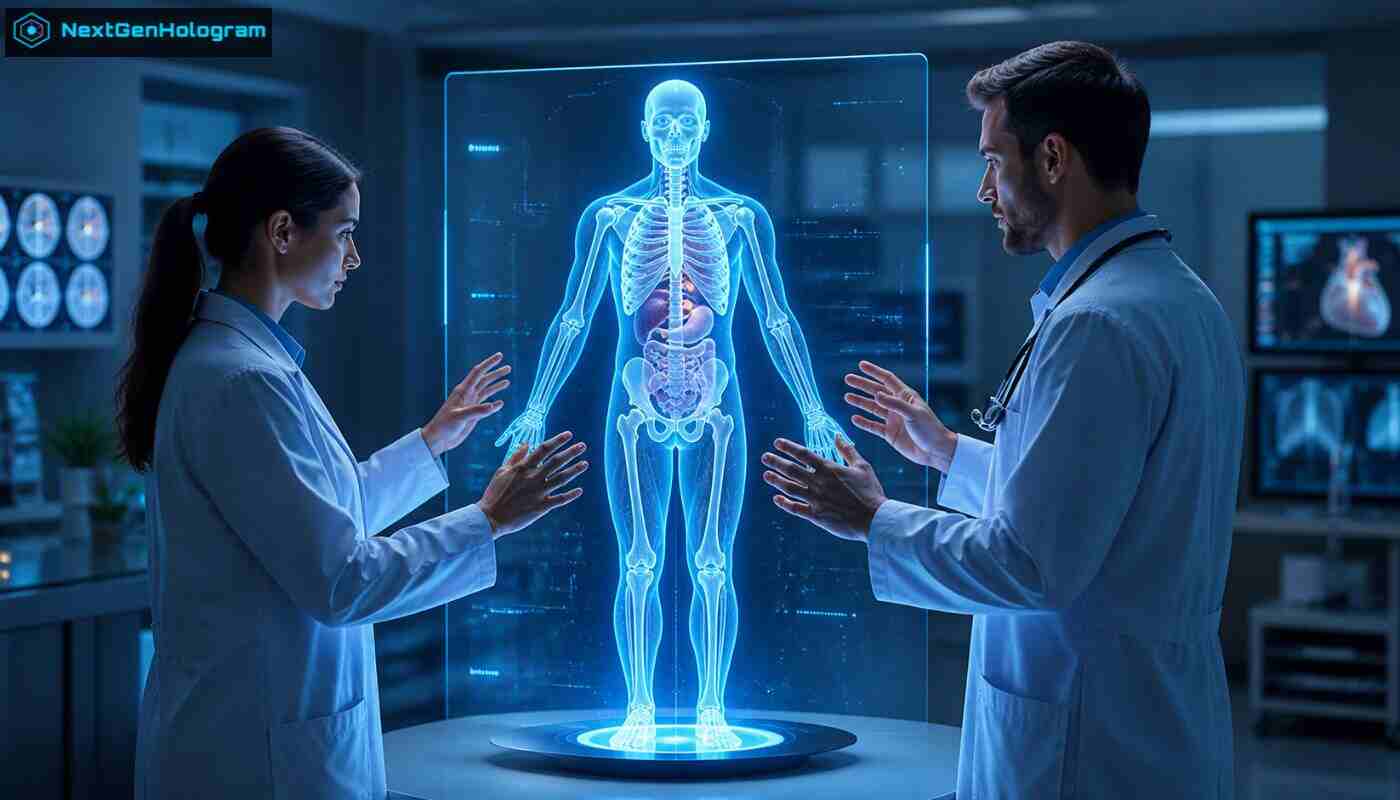
In the medical industry, the hologram technology has played a significant role in customising surgical methods, testing, diagnosis, pre-planning and awareness. This provides easy support for medical professionals by converting 2D CT scans into 3D prototypes. Doctors can view tumours, bone structures and organs in high resolution, decreasing threats in complicated procedures. This way, holograms in healthcare assist doctors as well as patients in understanding the complicated medical details in an easy way. Access the best hologram in healthcare given in this write-up, like an overview, how it benefits, hologram applications in the medical sector and more.
About the Hologram in Healthcare
Hologram acts as a key centre in the technological conversion recently. These hologram models are now being utilised to fight the shortage of health workers, bringing medical professionals to patients in a new way.
This creative formula utilises lifelike and 3D holograms to connect doctors with patients when they are too far away. By using advanced holographic screens such as Holobox, this reach offers a human touch to imaginary care, maintaining the space between individual and technological connection.
Introducing A Troublesome Healthcare Challenge
During the pandemic, hospitals and clinics faced a severe shortage of healthcare workers across the United States. This had left multiple patients without proper medical care during this tough time. 3D hologram model in healthcare provides a strong reaction to this shortage by allowing doctors to appear in several destinations, removing the barriers of physical distance.
Patients engage with their medical professionals via a holographic interface. This allows real-time discussions. Despite conventional telehealth formulas, holograms offer a more associative and human-like experience, enhancing communication and facilitating trust. This creation can be effective in distant or rural regions, where doctors are available in low numbers.
Transforming Healthcare Industries
Hologram technology has turned the medical sector by changing two-dimensional data from ultrasound, MRI and CT scan into engaging and high-resolution 3D images. Hospitality, shows, education and retail browse the opportunities of holographic technology to improve interaction and enhance experiences. Businesses have changed the way they interact with consumers, students and viewers with the 3D hologram explanation in healthcare.
How Hologram Transformed the Medical Field?
With the help of hologram in healthcare, medical professionals offer excellent care in multiple ways, like tumour localisation, surgery, distant therapy and medical training. A few examples are given below of how hologram technology is assisting doctors to enhance their results and skills.
-
Surgery - Holograms can offer doctors 3D images of a patient’s internal body structure that enable them to prepare and perform complicated procedures with more confidence and exactness. Suppose holograms can assist doctors in browsing across the specific tissue structures and ignore inessential damage. Doctors can view the bones or organs of patients in a more engaging and immersive way, displaying them in 3D visuals, which can be significant for evaluating infections or fractures.
-
Tumour Position - 3D holograms assist medical professionals to find tumours more securely and appropriately if present deep inside the human body or near critical organs. Doctors can find the exact shape and position of a brain tumour before surgery through a 3D hologram model. They can take the help of chemotherapy or radiation therapy that aims only at cancerous cells and reduces side effects.
-
Healthcare Training - Hologram technology can improve healthcare education by offering students original 3D prototypes of physiology and human anatomy. Learners can engage with holograms using voice commands or gestures that can enhance their structural knowledge and awareness of complicated methods. Holograms can replicate multiple situations that learners can face in practice, like cardiac arrest or trauma.
-
Distant Therapy - With holograms, medical professionals offer precise treatment or consultation to patients who are far away or can’t travel. Medical professionals can discuss with patients who have chronic diseases or mental health issues. They use 3D avatars that resemble their body language and facial reactions. They also assist patients in managing anxiety or pain by generating an associative atmosphere that diverts them from inconvenience.
Final Words
So, holograms have played a significant part in customising the medical sector. This technology is still emerging and has shown immense capability for the healthcare industry. By offering medical professionals a complete awareness of damage or disease and avoiding misconceptions, hologram technology can transform association and communication in medicine. This can result in better treatment, diagnosis and elimination of your multiple health issues, offering excellent well-being and satisfaction. To know more about the 3D hologram explanation, connect with Next Gen Hologram customer care number.
FAQs
Ques. How is the 3D hologram model helping doctors in surgery?
Ans. Holograms provide the 3D prototypes of the internal body structure of humans, like organs, cells and tissues, and doctors can plan, estimate and prepare before surgery or treatment.
Ques. Are holograms secured for the eyes in the medical sector?
Ans. Yes, holograms are safe for the eyes. They depend on light methods and don’t emit destructive radiation.