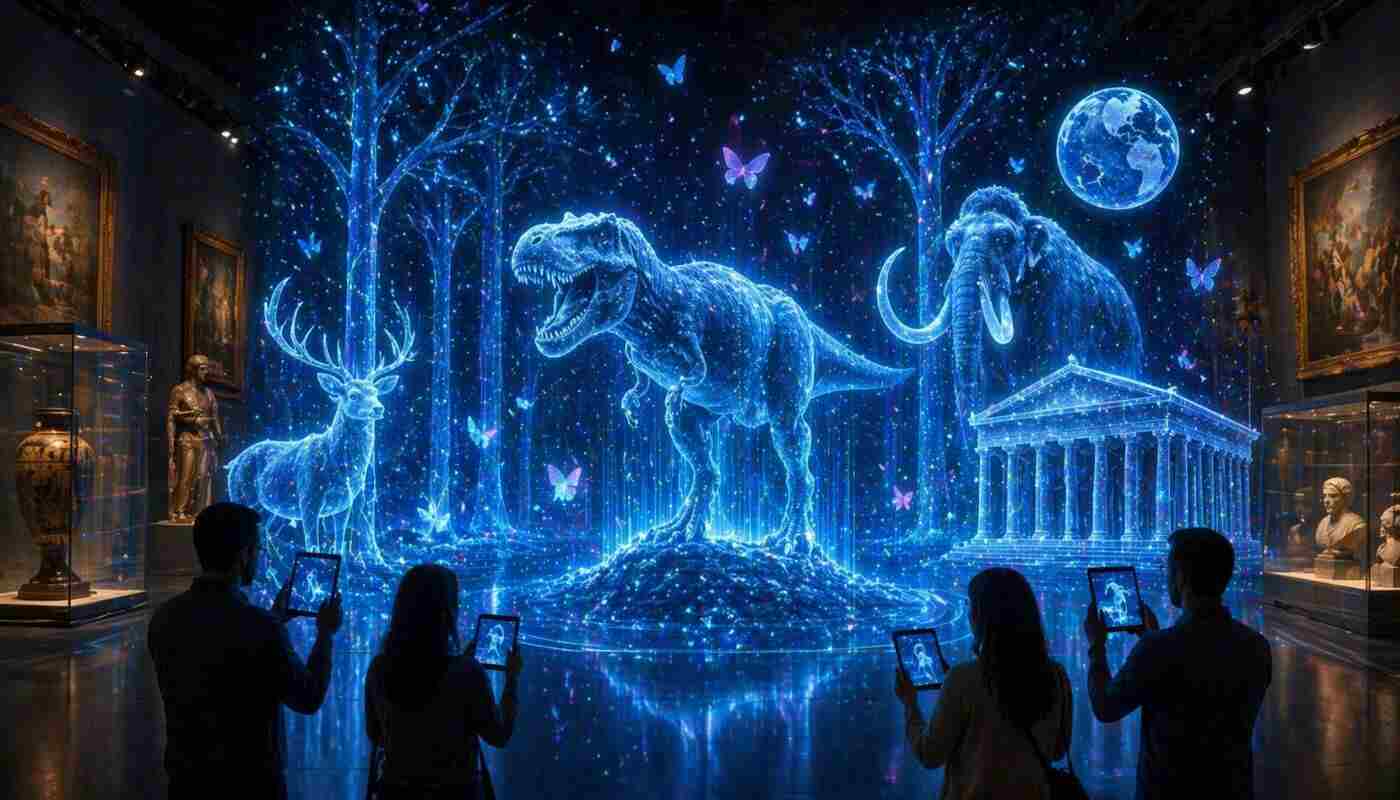
Today, many museums are using holograms in museums to turn static displays into dynamic, interactive experiences. Those 3D pseudo-renderings of artifacts, individuals, or places bring visitors into the exhibit to handle objects or observe animated reconstructions suspended in mid-air. Properly organized, this installation of Hologram at museums will enhance engagement, learning, and repeat visits.
1. Preserving Fragile or Inaccessible Artifacts
A good application for Hologram in museums is to exhibit objects margined by being very fragile or rare, or too large to transport. With a holographic model of a painted manuscript, fossil, or industrial machine, all viewpoints are depicted in true size, and the artifact could be rotated in space and enlarged with no risk to the object itself.
This kind of thinking will also allow museums to “recreate” in 3D the art lost or heavily damaged in centuries gone by, thereby providing visitors with a highly realistic rendition of the strongly felt connection to symbolic legitimacy gone by.
2. Making Historical Persons and Events Live
Many museums have taken to projecting the ghosts of historical figures—war leaders, artists, local heroes—onto the stage of their hologram presentations, wherein they “speak” to audiences. The representation can be based on real footage, presented alongside relevant archival fusion, or created artificially with the help of AI that spontaneously generates questions through Q&A. In this way, the past emerges with an immediacy and significance it would otherwise lack.
The figure can be said to really exist within our own space, or rather from some distance; the viewers can walk around and engage with the story from different angles. Thus, it becomes a painting of a biographical panel transplanted into a minitheater.
3. Creation of 3D Timelines and 360° Environments
The holographic museum can display 3D timelines with city reconstructions or maps of ecosystems, all viewed by the museum-goers from a central pedestal or under a dome-shaped display. Instead of a flat map or timeline, the rotation of Earth's 3D globe can be watched, see an urban centre grow over centuries, or see an ecosystem in a forest transforming with seasons.
These 360° displays are extremely helpful in exhibitions for actual scientific, archaeological, and city historical explanation, where the space occupied always says a lot more than the text.
4. Interactive Learning Hands-Free
Many hologram systems in museums now provide touchless or gesture-based controls, allowing viewers to "manipulate" a 3D object without screens or remotes. A child can "turn" a dinosaur skeleton, open a virtual engine, or "peel off" layers of the cross-section of a building, just by moving his hands.
Interactivity certainly makes learning fun, especially for themes or visits and family-based hologram entertainment zones.
5. Guides, Navigation, and Story Integrity
A hologram company uses interactive holographic guides or "museum hosts" to appear at critical entryways or junctions of exhibits. These holographic personalities will direct the flow of the crowd, explain topic changes, or even give short story-based holographic explanations on intricate displays.
In such a way is how a Hologram in museums displays turns not just a standalone view but a guiding thread that connects galleries! This thread helps visitors keep the entire storyline pressed back into their minds.
Why Hologram in Museums Works So Well?
It is not only an oddity but also genuinely boosts interaction time for more profound engagement and to provide blank-notch memory recalls to the display proposition. For keepers, it is a way to work with the originals safely, gives them further reach, and might pull a young, digitally aware crowd to the display. For visitors, passively strolling across the glass showcases turns into a dynamic, interactive trip across time, science, and culture.